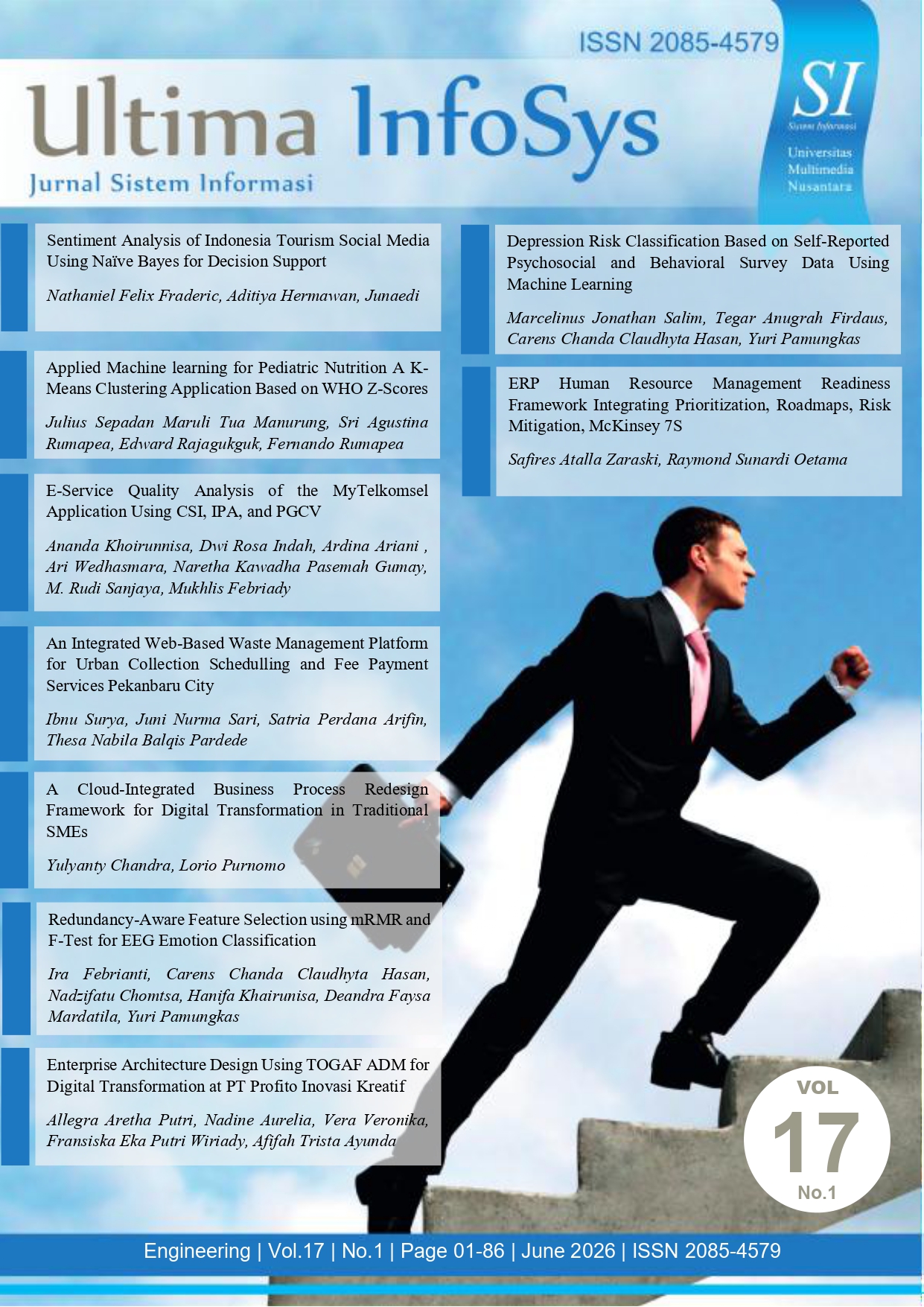
Sentiment Analysis of Indonesian Tourism Social Media Using Naïve Bayes for Decision Support
DOI:
https://doi.org/10.31937/si.v17i1.4139Abstract
The tourism sector remains one of the main contributors to Indonesia's economy, but its development is still challenged by inadequate communication and publication. Understanding visitors' opinions is essential for improving tourist destinations. This study aims to analyze public sentiment toward Indonesian tourist attractions by automatically processing visitor responses using sentiment analysis. The proposed approach applies text mining with the Naïve Bayes algorithm to classify sentiments efficiently. Data were collected through the X platform API using tourism-related keywords and hashtags, providing real-time public opinions on Indonesian destinations. A web-based application was developed using Python to visualize the sentiment analysis results as graphs showing the distribution of sentiment categories. The proposed model achieved an accuracy of 87%, demonstrating its effectiveness in classifying public responses. The findings provide useful insights for tourism stakeholders to evaluate visitor perceptions, identify areas for improvement, and support data-driven decision-making to enhance tourism services and visitor experiences. This study contributes to tourism research by applying the Naïve Bayes algorithm to Indonesian-language tweets related to tourist attractions, demonstrating the feasibility of text mining for automatically analyzing public opinion and supporting tourism development.
Downloads
Downloads
Published
How to Cite
Issue
Section
License
Copyright (c) 2026 Nathaniel Felix Fraderic; Aditiya Hermawan, Junaedi Junaedi

This work is licensed under a Creative Commons Attribution-ShareAlike 4.0 International License.
Authors retain copyright and grant the journal right of first publication with the work simultaneously licensed under a Creative Commons Attribution-ShareAlike International License (CC-BY-SA 4.0) that allows others to share the work with an acknowledgement of the work's authorship and initial publication in this journal.
Authors are able to enter into separate, additional contractual arrangements for the non-exclusive distribution of the journal's published version of the work (e.g., post it to an institutional repository or publish it in a book), with an acknowledgement of its initial publication in this journal.
Copyright without Restrictions
The journal allows the author(s) to hold the copyright without restrictions and will retain publishing rights without restrictions.
The submitted papers are assumed to contain no proprietary material unprotected by patent or patent application; responsibility for technical content and for protection of proprietary material rests solely with the author(s) and their organizations and is not the responsibility of the ULTIMA InfoSys or its Editorial Staff. The main (first/corresponding) author is responsible for ensuring that the article has been seen and approved by all the other authors. It is the responsibility of the author to obtain all necessary copyright release permissions for the use of any copyrighted materials in the manuscript prior to the submission.