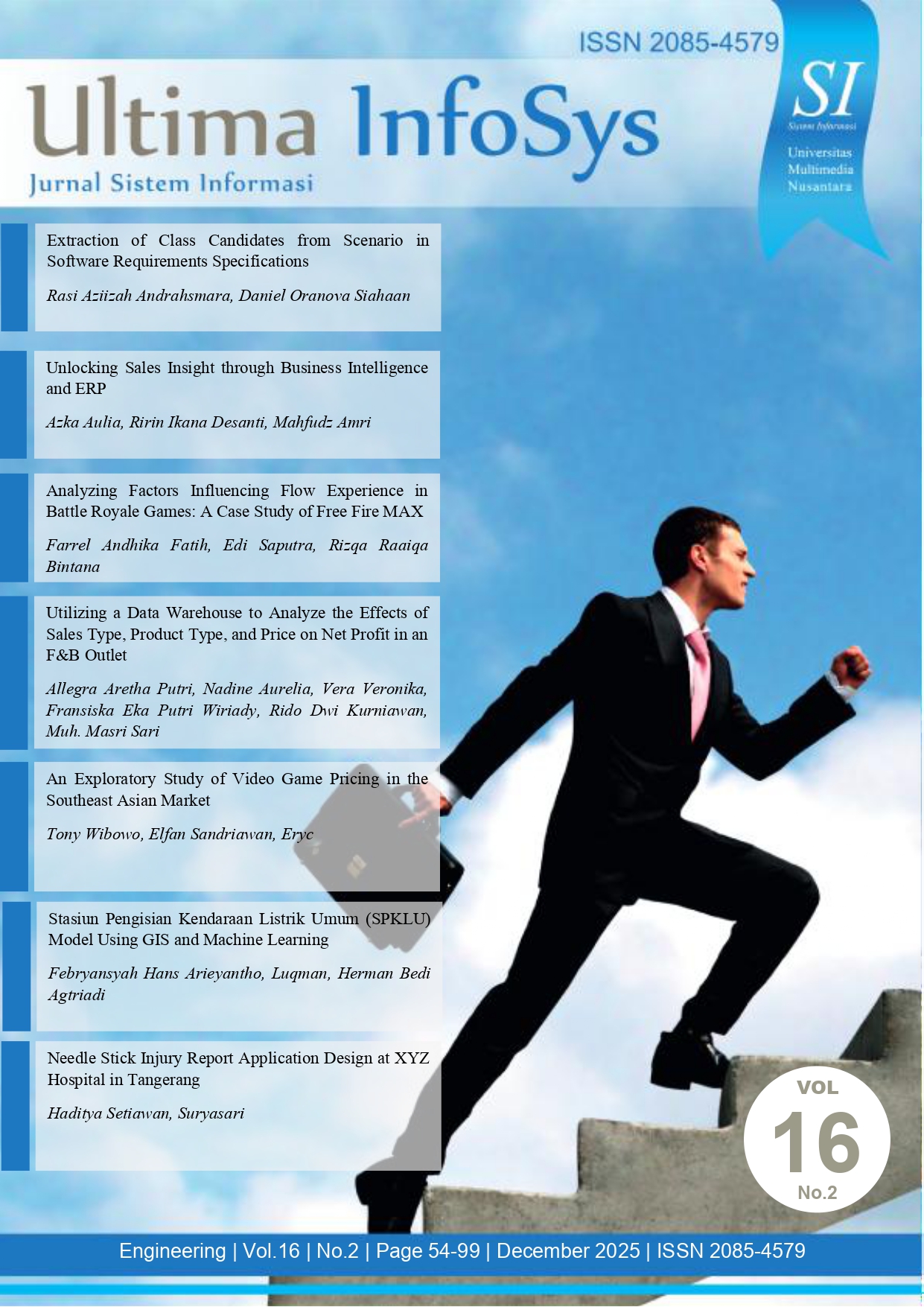
Extraction of Class Candidates from Scenario in Software Requirements Specifications
DOI:
https://doi.org/10.31937/si.v16i2.4325Abstract
The development of software applications involves translating software requirement specifications (SRS) into structured models that guide system design. Among these, sequence diagrams are essential for visualizing dynamic interactions, but their manual construction from natural language descriptions is often error-prone and time-consuming. This study proposes an automated method for extracting sequence diagram elements namely classes, subclasses, and attributes from scenario sections of SRS documents. The approach leverages Natural Language Processing (NLP) techniques, combining Bidirectional Encoder Representations from Transformers (BERT) for contextual embeddings and Support Vector Machine (SVM) for classification. Noun phrases are identified and classified into UML-relevant entities using this hybrid model. To evaluate performance, two datasets SIData and SILo were used, each exhibiting distinct textual styles and domain characteristics. The system’s effectiveness was assessed using standard evaluation metrics such as precision, recall, and F1-score. Results indicate that the method is capable of capturing contextual relationships between extracted elements, although its performance varies across datasets, suggesting the need for further refinement. Overall, the study contributes toward automating early software design phases and reducing manual modeling effort.
Downloads
Downloads
Published
How to Cite
Issue
Section
License
Copyright (c) 2025 Rasi Aziizah Andrahsmara

This work is licensed under a Creative Commons Attribution-ShareAlike 4.0 International License.
Authors retain copyright and grant the journal right of first publication with the work simultaneously licensed under a Creative Commons Attribution-ShareAlike International License (CC-BY-SA 4.0) that allows others to share the work with an acknowledgement of the work's authorship and initial publication in this journal.
Authors are able to enter into separate, additional contractual arrangements for the non-exclusive distribution of the journal's published version of the work (e.g., post it to an institutional repository or publish it in a book), with an acknowledgement of its initial publication in this journal.
Copyright without Restrictions
The journal allows the author(s) to hold the copyright without restrictions and will retain publishing rights without restrictions.
The submitted papers are assumed to contain no proprietary material unprotected by patent or patent application; responsibility for technical content and for protection of proprietary material rests solely with the author(s) and their organizations and is not the responsibility of the ULTIMA InfoSys or its Editorial Staff. The main (first/corresponding) author is responsible for ensuring that the article has been seen and approved by all the other authors. It is the responsibility of the author to obtain all necessary copyright release permissions for the use of any copyrighted materials in the manuscript prior to the submission.