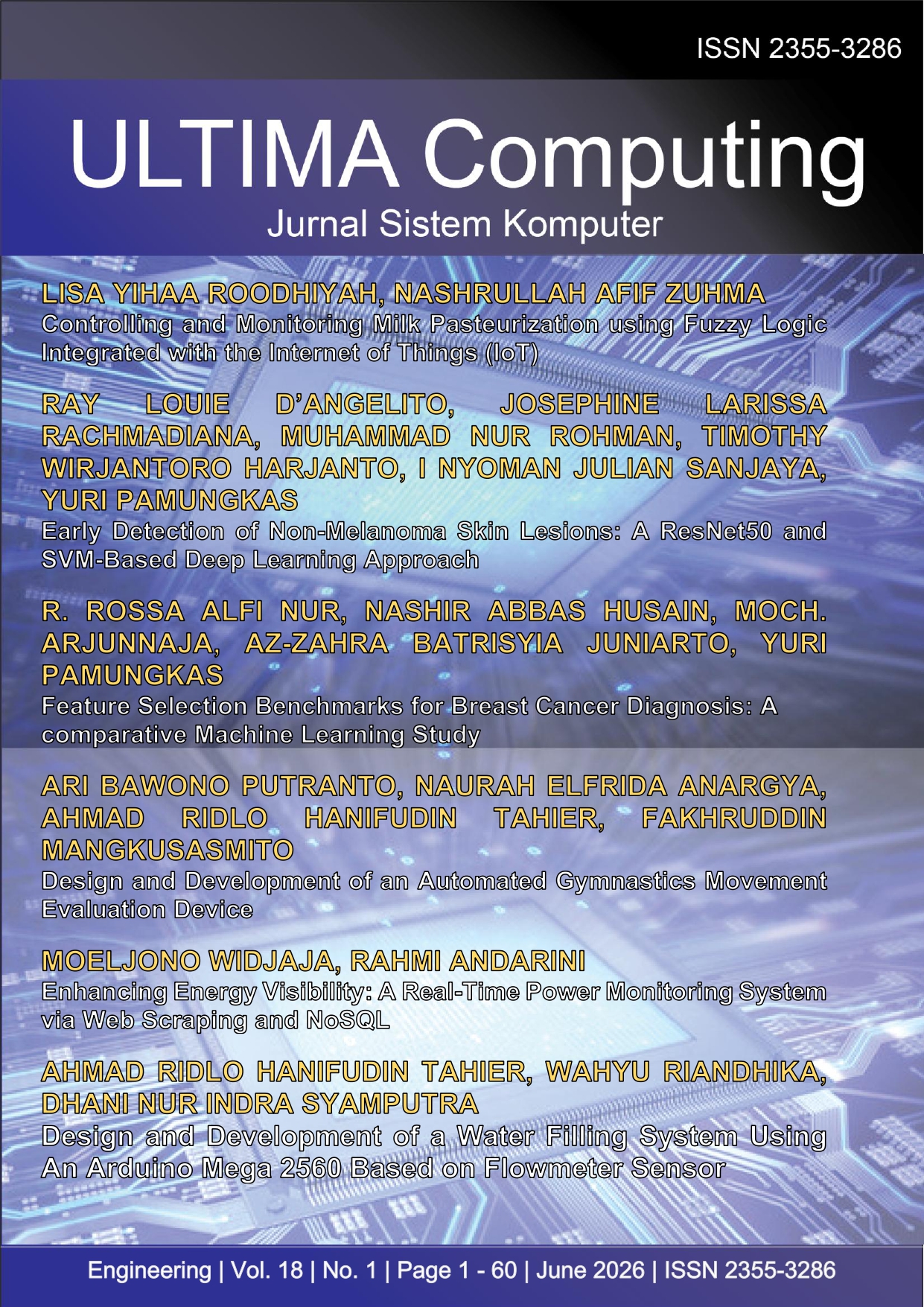
Design and Development of a Water Filling System Using An Arduino Mega 2560 Based on Flowmeter Sensor
DOI:
https://doi.org/10.31937/sk.v18i1.4650Abstract
The utilisation of automation technology is undergoing rapid proliferation in the industrial sector, including in the bottled drinking water industry. The objective of this study is to design and implement an automation system for filling bottled drinking water with a range of 30–330 millilitres using an Arduino Mega 2560 as the controller. The setpoint is determined by calibrating the pulse value obtained based on the time delay in filling volumes in multiples of 30 at values ranging from 30 to 330 millilitres. The accuracy value for volumes of 30 and 60 millilitres was found to be 99.3%, while volumes of 60-330 millilitres demonstrated an accuracy level of >99.6%. Subsequently, the system was integrated with a conveyor and E18-D80NK proximity sensor to detect bottles during the filling process, and a counter to enumerate the bottles post-water filling. Preliminary testing indicated that the system demonstrated a capacity for precise bottle filling, with an error margin of less than 1%. This finding suggests that the system exhibits a low level of inaccuracy and responsiveness.
Downloads
Downloads
Published
How to Cite
Issue
Section
License
Copyright (c) 2026 Ahmad Ridlo Hanifudin Tahier, Wahyu Riandika, Dhani Nur Indra Syamputra

This work is licensed under a Creative Commons Attribution-ShareAlike 4.0 International License.
Authors retain copyright and grant the journal right of first publication with the work simultaneously licensed under a Creative Commons Attribution-ShareAlike International License (CC-BY-SA 4.0) that allows others to share the work with an acknowledgment of the work's authorship and initial publication in this journal.
Authors are able to enter into separate, additional contractual arrangements for the non-exclusive distribution of the journal's published version of the work (e.g., post it to an institutional repository or publish it in a book), with an acknowledgment of its initial publication in this journal.
Copyright without Restrictions
The journal allows the author(s) to hold the copyright without restrictions and will retain publishing rights without restrictions.
The submitted papers are assumed to contain no proprietary material unprotected by patent or patent application; responsibility for technical content and for protection of proprietary material rests solely with the author(s) and their organizations and is not the responsibility of the ULTIMA Computing or its Editorial Staff. The main (first/corresponding) author is responsible for ensuring that the article has been seen and approved by all the other authors. It is the responsibility of the author to obtain all necessary copyright release permissions for the use of any copyrighted materials in the manuscript prior to the submission.