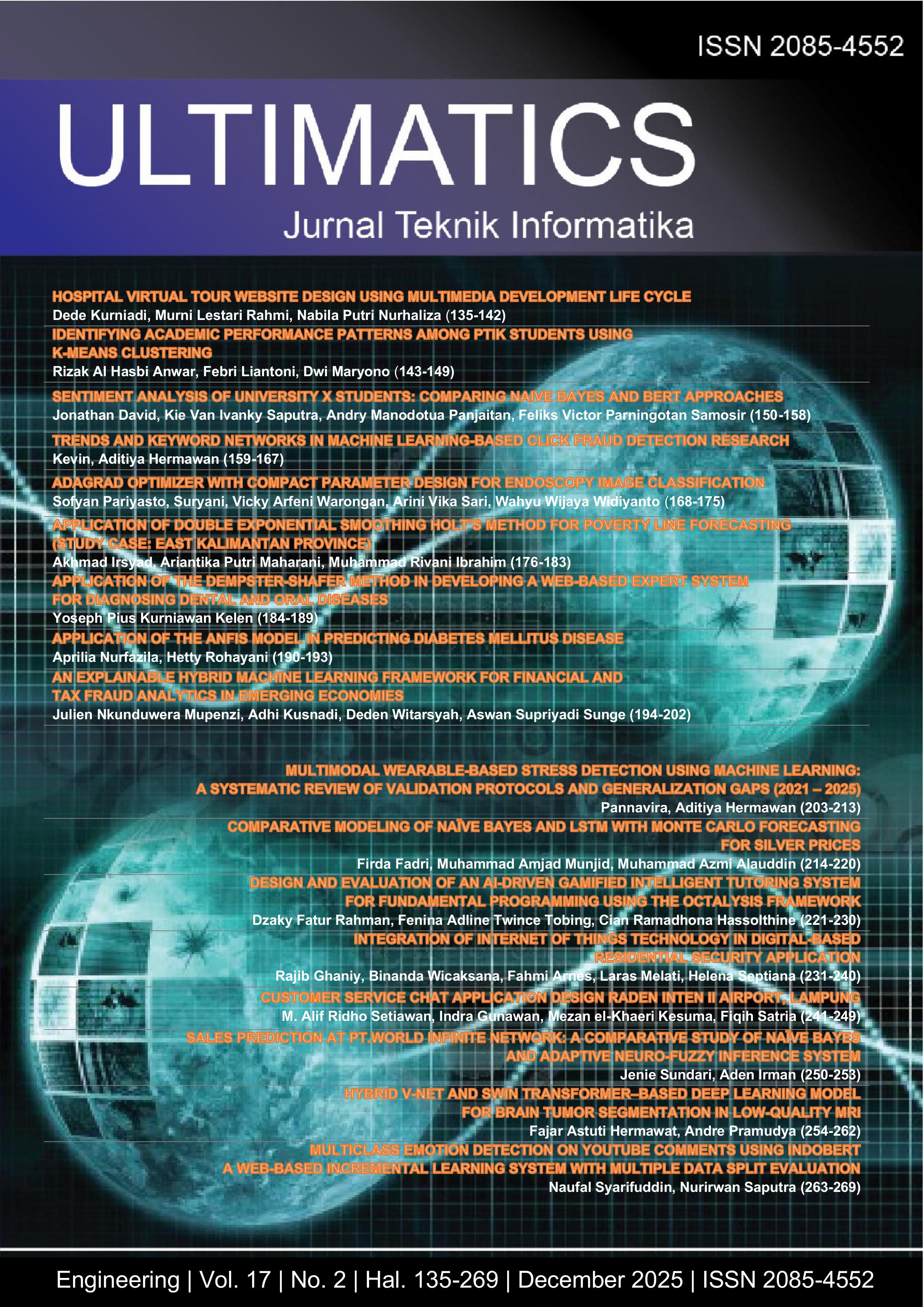
Hospital Virtual Tour Website Design Using Multimedia Development Life Cycle
DOI:
https://doi.org/10.31937/ti.v17i2.3832Abstract
In 2023, Indonesia recorded 3,155 hospitals spread across the country, comprising 2,636 general and 519 specialized hospitals. Although the number is significant, not all community members have easy, direct access to hospitals. To overcome this challenge, virtual tour technology has emerged as a relevant solution to facilitate access to information and increase the transparency of hospital services. This project aims to develop a virtual tour website for Medina Hospital in Garut Regency. The project uses a systematic development method known as the Multimedia Development Life Cycle (MDLC), which includes stages from concept to distribution. The resulting website allows users to explore various hospital areas, such as the Main Building, Emergency Room, Tulip Building, and Chemotherapy Poly, through a virtual 360-degree panoramic view. Additionally, building and floor selection features are designed to make it easy for users to navigate. This website is also equipped with a chatbot feature that helps users find the location of a specific room and video tutorial guides that provide instructions for using the website. The results of the black box test show that the website functions well without any significant technical problems, so it is ready for public use. This website is expected to increase accessibility and convenience for users in obtaining information about the facilities and rooms available at Medina Hospital.
Downloads
Additional Files
Published
How to Cite
Issue
Section
License
Copyright (c) 2026 Dede Kurniadi, Murni Lestari Rahmi, Nabila Putri Nurhaliza

This work is licensed under a Creative Commons Attribution-ShareAlike 4.0 International License.
Authors retain copyright and grant the journal right of first publication with the work simultaneously licensed under a Creative Commons Attribution-ShareAlike International License (CC-BY-SA 4.0) that allows others to share the work with an acknowledgement of the work's authorship and initial publication in this journal.
Authors are able to enter into separate, additional contractual arrangements for the non-exclusive distribution of the journal's published version of the work (e.g., post it to an institutional repository or publish it in a book), with an acknowledgement of its initial publication in this journal.
Copyright without Restrictions
The journal allows the author(s) to hold the copyright without restrictions and will retain publishing rights without restrictions.
The submitted papers are assumed to contain no proprietary material unprotected by patent or patent application; responsibility for technical content and for protection of proprietary material rests solely with the author(s) and their organizations and is not the responsibility of the ULTIMATICS or its Editorial Staff. The main (first/corresponding) author is responsible for ensuring that the article has been seen and approved by all the other authors. It is the responsibility of the author to obtain all necessary copyright release permissions for the use of any copyrighted materials in the manuscript prior to the submission.