
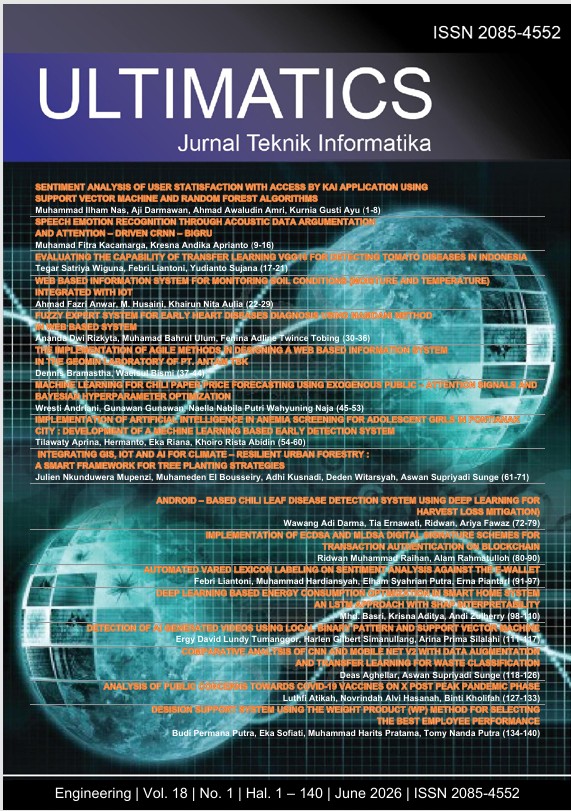
Sentiment Analysis of User Satisfaction with Access by KAI Application Using Support Vector Machine and Random Forest Algorithms
DOI:
https://doi.org/10.31937/ti.v18i1.3878Abstract
PT Kereta Api Indonesia (Persero), a State-Owned Enterprise (SOE) in the railway sector, holds an important responsibility in providing efficient services. To enhance their services, they introduced the application "Access by KAI.” Although this application represents a technological innovation, it often falls short of users' expectations due to existing shortcomings. Therefore, this study proposes the use of sentiment analysis to gauge users' perspectives on the "Access by KAI” application. By applying Support Vector Machine (SVM) and Random Forest algorithms to user review datasets, this study classifies user sentiments into three categories: positive, neutral and negative, and compares the performance of these two algorithms. The results of this study offer valuable insights into users' attitudes towards the application, which can assist PT Kereta Api Indonesia in improving service quality. The classification results using the Random Forest and Support Vector Machine (SVM) algorithms, based on the factors used in this study, show varying performance. Random Forest achieved an accuracy of 86% for an 80:20 and 90:10 data ratios, and 85% for a 70:30 ratio, while SVM achieved 83% accuracy across different data ratios
Downloads
Additional Files
Published
How to Cite
Issue
Section
License
Copyright (c) 2026 Kurnia Gusti Ayu

This work is licensed under a Creative Commons Attribution-ShareAlike 4.0 International License.
Authors retain copyright and grant the journal right of first publication with the work simultaneously licensed under a Creative Commons Attribution-ShareAlike International License (CC-BY-SA 4.0) that allows others to share the work with an acknowledgement of the work's authorship and initial publication in this journal.
Authors are able to enter into separate, additional contractual arrangements for the non-exclusive distribution of the journal's published version of the work (e.g., post it to an institutional repository or publish it in a book), with an acknowledgement of its initial publication in this journal.
Copyright without Restrictions
The journal allows the author(s) to hold the copyright without restrictions and will retain publishing rights without restrictions.
The submitted papers are assumed to contain no proprietary material unprotected by patent or patent application; responsibility for technical content and for protection of proprietary material rests solely with the author(s) and their organizations and is not the responsibility of the ULTIMATICS or its Editorial Staff. The main (first/corresponding) author is responsible for ensuring that the article has been seen and approved by all the other authors. It is the responsibility of the author to obtain all necessary copyright release permissions for the use of any copyrighted materials in the manuscript prior to the submission.