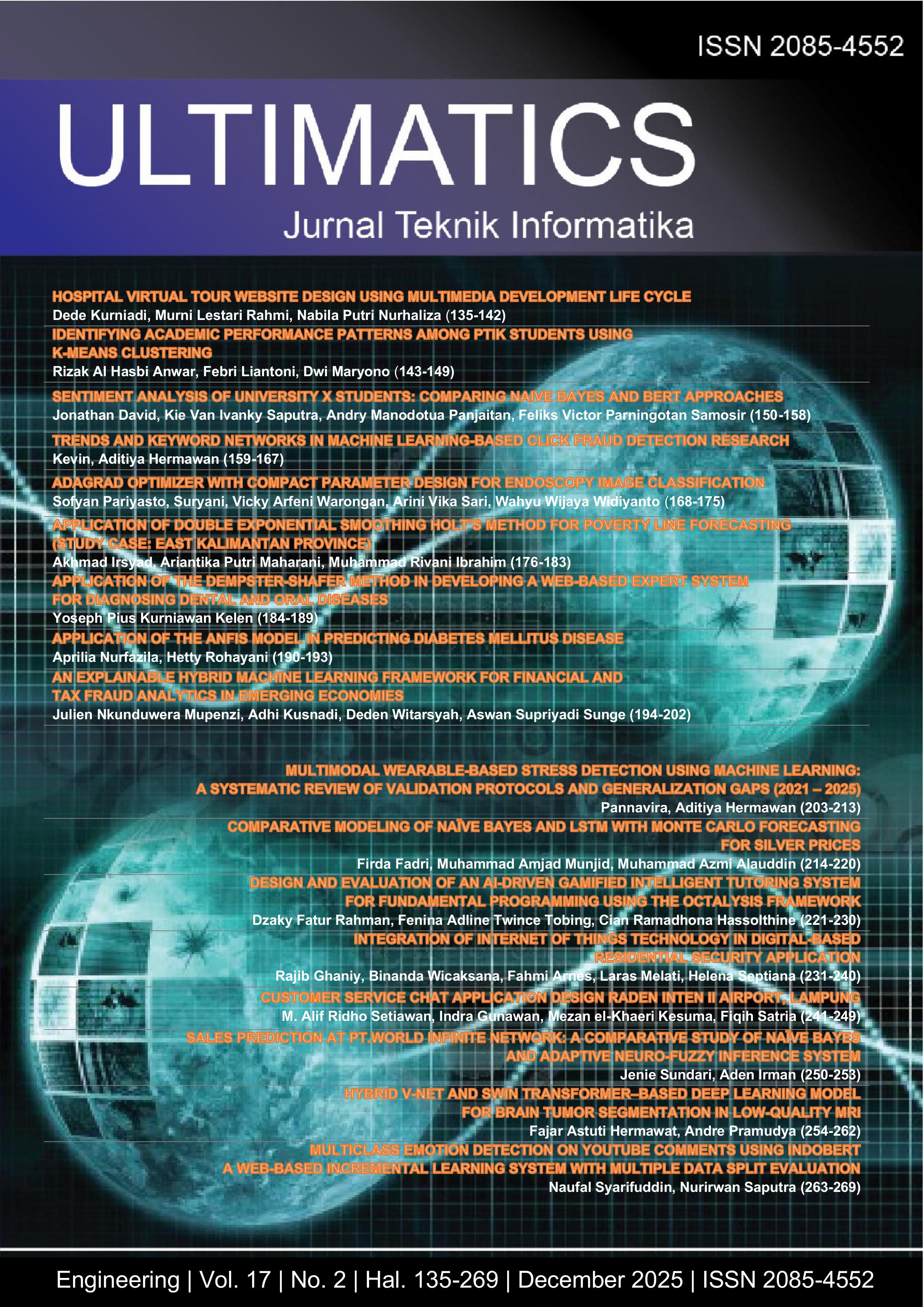
Sentiment Analysis of University X Students
Comparing Naive Bayes and BERT Approaches
DOI:
https://doi.org/10.31937/ti.v17i2.4034Abstract
Student satisfaction with university facilities and services requires in-depth analysis to ensure improvements in unsatisfactory facilities or services while maintaining those that meet expectations. This study aims to analyze sentiment in student satisfaction surveys using Natural Language Processing (NLP) methods. Survey data collected from 2022 to 2024 were analyzed using two main approaches: Naive Bayes (NB) with n-grams (n=1,2,3) employing feature extraction methods such as Term Frequency-Inverse Document Frequency (TF-IDF) and Bag of Words (BoW), and Bidirectional Encoder Representations from Transformers (BERT). The analysis results indicate that BERT outperforms NB in terms of sentiment prediction accuracy, although the difference is not highly significant. This study also identified keywords for both positive and negative sentiments. These keywords were then analyzed across 11 categories of facilities and services to provide focused insights into aspects that need to be maintained or improved. This study concludes that sentiment analysis provides significant contributions to universities in evaluating and enhancing the quality of facilities and services according to student preferences.
Downloads
Additional Files
Published
How to Cite
Issue
Section
License
Copyright (c) 2026 Jonathan David, Kie Van Ivanky Saputra, Andry Manodotua Panjaitan, Feliks Victor Parningotan Samosir

This work is licensed under a Creative Commons Attribution-ShareAlike 4.0 International License.
Authors retain copyright and grant the journal right of first publication with the work simultaneously licensed under a Creative Commons Attribution-ShareAlike International License (CC-BY-SA 4.0) that allows others to share the work with an acknowledgement of the work's authorship and initial publication in this journal.
Authors are able to enter into separate, additional contractual arrangements for the non-exclusive distribution of the journal's published version of the work (e.g., post it to an institutional repository or publish it in a book), with an acknowledgement of its initial publication in this journal.
Copyright without Restrictions
The journal allows the author(s) to hold the copyright without restrictions and will retain publishing rights without restrictions.
The submitted papers are assumed to contain no proprietary material unprotected by patent or patent application; responsibility for technical content and for protection of proprietary material rests solely with the author(s) and their organizations and is not the responsibility of the ULTIMATICS or its Editorial Staff. The main (first/corresponding) author is responsible for ensuring that the article has been seen and approved by all the other authors. It is the responsibility of the author to obtain all necessary copyright release permissions for the use of any copyrighted materials in the manuscript prior to the submission.