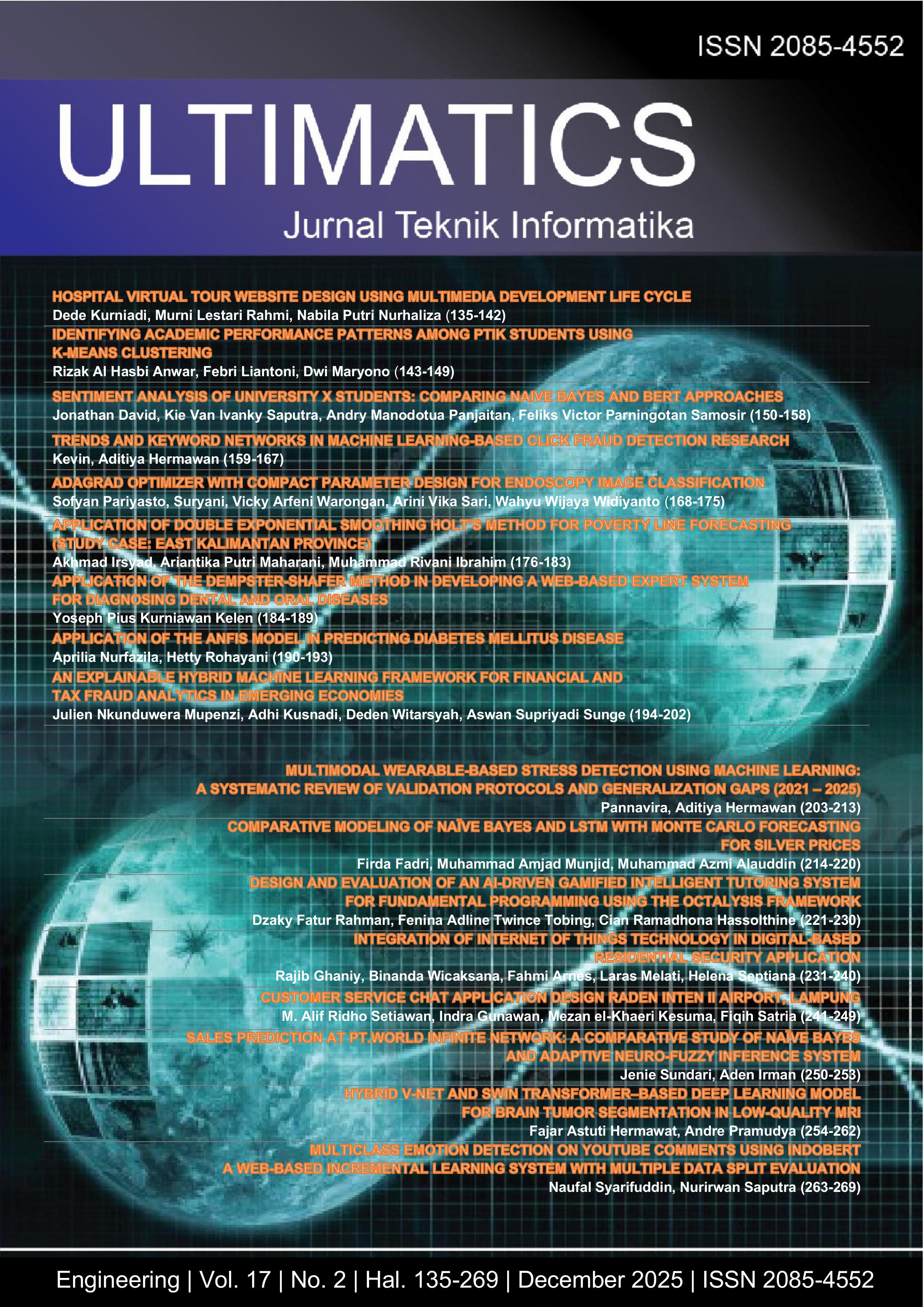
Trends and Keyword Networks in Machine Learning-Based Click Fraud Detection Research
DOI:
https://doi.org/10.31937/ti.v17i2.4131Abstract
The rapid advancement of the digital economy has significantly increased the use of online advertising while concurrently giving rise to critical challenges, particularly in the form of click fraud”a manipulative act that harms advertisers by generating fraudulent clicks on digital advertisements. As click fraud attack patterns grow increasingly complex, machine learning (ML)-based research has emerged as a principal approach for detecting and mitigating these threats. This study aims to map the research landscape of ML-based click fraud detection through a bibliometric analysis to identify publication trends, patterns of international and institutional collaboration, and key thematic domains within this field. Employing a bibliometric methodology, the study analyzed 61 publications retrieved from Dimensions.ai spanning the years 2015–2024. The data were collected, refined using OpenRefine, and visualized with VOSviewer to examine keyword co-occurrences and research trends. The findings reveal a marked increase in publication volume since 2019, with dominant contributions from India, China, Saudi Arabia, and the United States. Furthermore, four principal research clusters were identified: cybersecurity, the relationship between click fraud and the digital advertising industry, dataset processing and evaluation techniques, and the development of ML-based detection systems. Each cluster offers practical contributions in areas such as system protection strategies, ad budget optimization, improved detection accuracy, and the development of scalable, real-time detection solutions. Recent trends highlight growing scholarly interest in model performance evaluation and the challenges posed by class imbalance (class skewness). This study concludes that more effective data management and the development of adaptive ML models capable of addressing evolving attack patterns are pivotal for future research. By providing a clearer mapping of current trends, this study aims to support the scientific community in developing more accurate and efficient click fraud detection strategies, thereby strengthening the integrity of the global digital advertising ecosystem.
Downloads
Additional Files
Published
How to Cite
Issue
Section
License
Copyright (c) 2026 Kevin Kevin, Aditiya Hermawan

This work is licensed under a Creative Commons Attribution-ShareAlike 4.0 International License.
Authors retain copyright and grant the journal right of first publication with the work simultaneously licensed under a Creative Commons Attribution-ShareAlike International License (CC-BY-SA 4.0) that allows others to share the work with an acknowledgement of the work's authorship and initial publication in this journal.
Authors are able to enter into separate, additional contractual arrangements for the non-exclusive distribution of the journal's published version of the work (e.g., post it to an institutional repository or publish it in a book), with an acknowledgement of its initial publication in this journal.
Copyright without Restrictions
The journal allows the author(s) to hold the copyright without restrictions and will retain publishing rights without restrictions.
The submitted papers are assumed to contain no proprietary material unprotected by patent or patent application; responsibility for technical content and for protection of proprietary material rests solely with the author(s) and their organizations and is not the responsibility of the ULTIMATICS or its Editorial Staff. The main (first/corresponding) author is responsible for ensuring that the article has been seen and approved by all the other authors. It is the responsibility of the author to obtain all necessary copyright release permissions for the use of any copyrighted materials in the manuscript prior to the submission.