
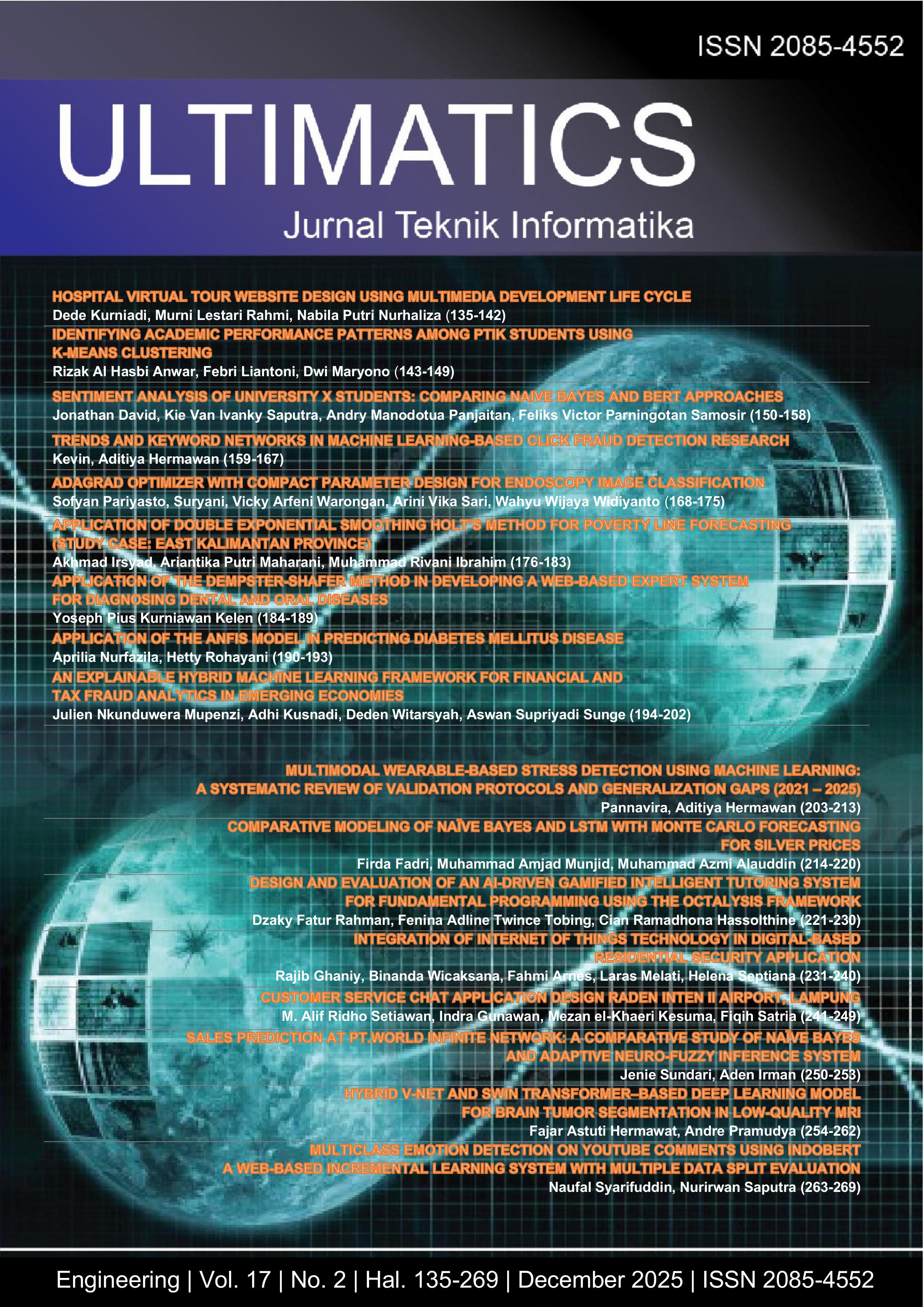
Application Of Double Exponential Smoothing Holt’s Method For Poverty Line Forecasting (Study Case: East Kalimantan Province)
DOI:
https://doi.org/10.31937/ti.v17i2.4349Abstract
Poverty is a multidimensional problem that remains a challenge in Indonesia. The poverty line is used as an indicator to determine whether someone is poor based on the average expenditure per capita per month. In East Kalimantan Province, the poverty line has increased from Rp796,193 in 2023 to Rp853,997 in 2024. This study aims to forecast the poverty line for the next ten periods using Holt's Double Exponential Smoothing method. This method was chosen because the historical data shows an increasing trend from 2011 to 2024. The forecasting results show that this method is effective with a Mean Absolute Percentage Error (MAPE) value of 4.56%, and optimal parameters α = 0.98 and β = 0.01. The findings are expected to serve as a reference in decision-making regarding poverty alleviation policies in the future.
Downloads
Additional Files
Published
How to Cite
Issue
Section
License
Copyright (c) 2026 Ariantika Putri Maharani, Akhmad Irsyad, Muhammad Rivani Ibrahim

This work is licensed under a Creative Commons Attribution-ShareAlike 4.0 International License.
Authors retain copyright and grant the journal right of first publication with the work simultaneously licensed under a Creative Commons Attribution-ShareAlike International License (CC-BY-SA 4.0) that allows others to share the work with an acknowledgement of the work's authorship and initial publication in this journal.
Authors are able to enter into separate, additional contractual arrangements for the non-exclusive distribution of the journal's published version of the work (e.g., post it to an institutional repository or publish it in a book), with an acknowledgement of its initial publication in this journal.
Copyright without Restrictions
The journal allows the author(s) to hold the copyright without restrictions and will retain publishing rights without restrictions.
The submitted papers are assumed to contain no proprietary material unprotected by patent or patent application; responsibility for technical content and for protection of proprietary material rests solely with the author(s) and their organizations and is not the responsibility of the ULTIMATICS or its Editorial Staff. The main (first/corresponding) author is responsible for ensuring that the article has been seen and approved by all the other authors. It is the responsibility of the author to obtain all necessary copyright release permissions for the use of any copyrighted materials in the manuscript prior to the submission.