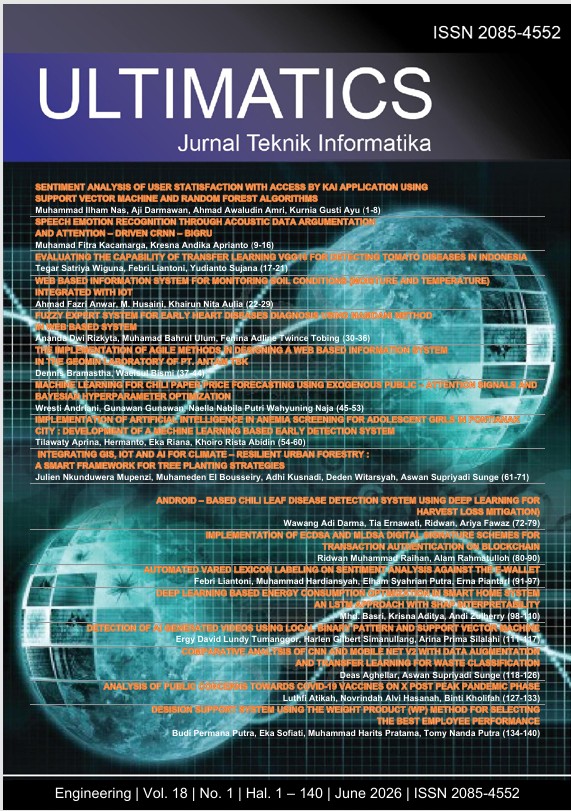
Android-Based Chili Leaf Disease Detection System Using Deep Learning For Harvest Loss Mitigation
DOI:
https://doi.org/10.31937/ti.v18i1.4492Abstract
Bird's eye chili productivity in Indonesia faces persistent decline due to leaf disease infections. Conventional visual inspection methods by farmers show limited accuracy (65-70%) and high subjectivity, causing delayed identification and yield losses. This study develops an Android-based detection system optimized for low-end mobile devices using deep learning with MobileNetV3-Large architecture enhanced through transfer learning. The dataset contains 5,000 annotated chili leaf images across healthy leaves and three disease types (anthracnose, bacterial spot, mosaic virus). Implementation includes quantization-aware training and TensorFlow Lite conversion for mobile optimization. Model evaluation uses 5-fold cross-validation with accuracy, precision, recall, and F1-score metrics. The model achieved 94.34% classification accuracy with 94.5% precision. Quantization reduced model size by 92.2% (75.6 MB to 5.9 MB) with only 0.3% accuracy loss. The Android application operates in real-time on 3GB RAM devices with inference latencies below 100ms. This system provides an effective solution combining high accuracy with computational efficiency for early chili leaf disease detection, supporting sustainable farming in Indonesia.
Index Terms---Deep learning; Mobile application; Plant disease detection; Chili leaf;
Downloads
Additional Files
Published
How to Cite
Issue
Section
License
Copyright (c) 2026 wawang adi darma, Tia Ernawati, Ridwan, Ariya Fawaz

This work is licensed under a Creative Commons Attribution-ShareAlike 4.0 International License.
Authors retain copyright and grant the journal right of first publication with the work simultaneously licensed under a Creative Commons Attribution-ShareAlike International License (CC-BY-SA 4.0) that allows others to share the work with an acknowledgement of the work's authorship and initial publication in this journal.
Authors are able to enter into separate, additional contractual arrangements for the non-exclusive distribution of the journal's published version of the work (e.g., post it to an institutional repository or publish it in a book), with an acknowledgement of its initial publication in this journal.
Copyright without Restrictions
The journal allows the author(s) to hold the copyright without restrictions and will retain publishing rights without restrictions.
The submitted papers are assumed to contain no proprietary material unprotected by patent or patent application; responsibility for technical content and for protection of proprietary material rests solely with the author(s) and their organizations and is not the responsibility of the ULTIMATICS or its Editorial Staff. The main (first/corresponding) author is responsible for ensuring that the article has been seen and approved by all the other authors. It is the responsibility of the author to obtain all necessary copyright release permissions for the use of any copyrighted materials in the manuscript prior to the submission.