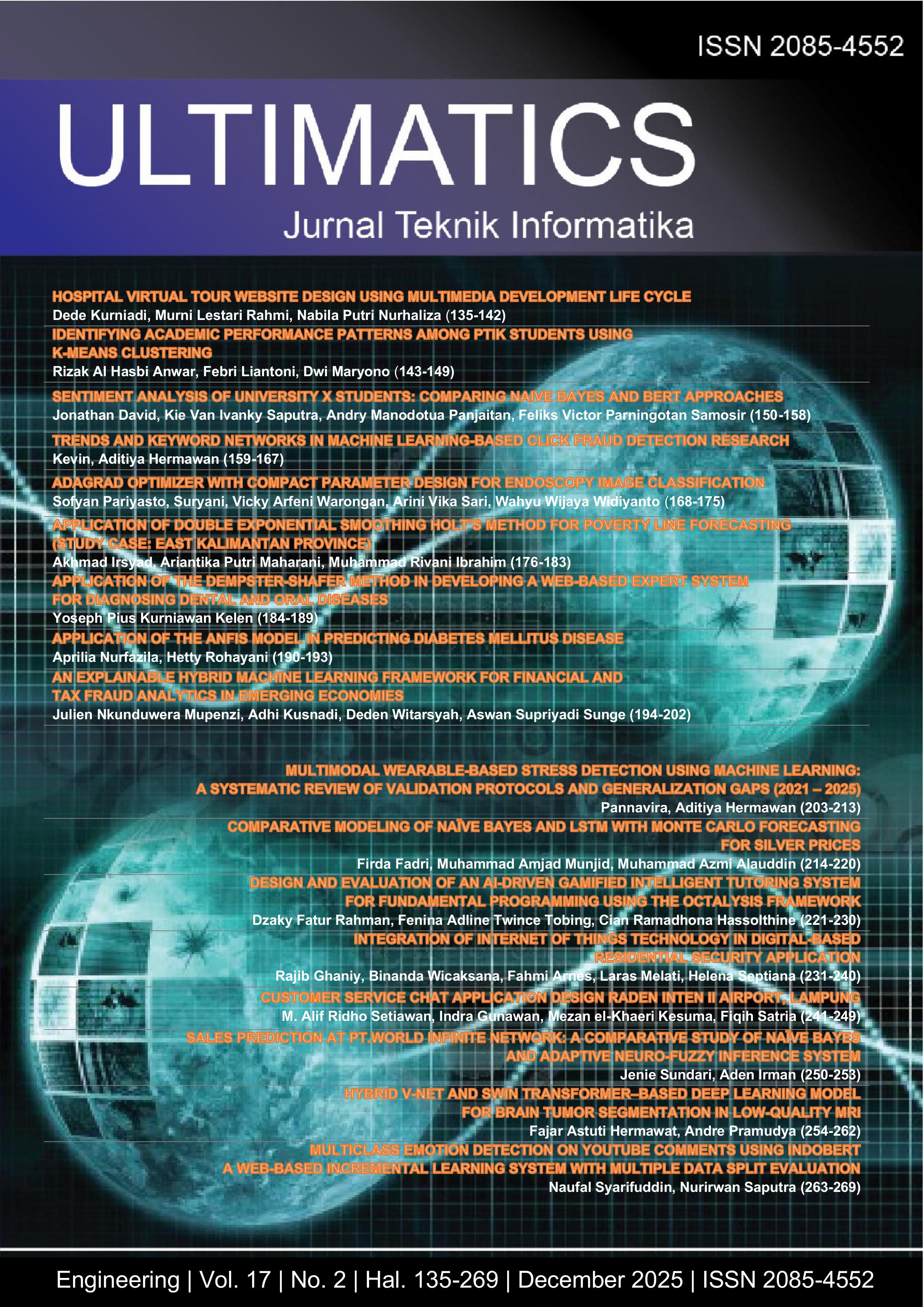
Hybrid V-Net And Swin Transformer Deep Learning Model For Brain Tumor Segmentation in Low-Quality MRI Scan
DOI:
https://doi.org/10.31937/ti.v17i2.4494Abstract
Brain tumor segmentation from low-quality magnetic resonance imaging (MRI) remains a challenging task due to noise, resolution variation, and low contrast between tumor and healthy tissues. Improving segmentation accuracy is essential to support more precise diagnosis and treatment planning. This study proposes a hybrid deep learning model that integrates V-Net and Swin Transformer architectures for automatic brain tumor segmentation in multimodal MRI images. The MICCAI BraTS 2020 dataset was used, consisting of T1, T1c, T2, and FLAIR sequences with corresponding segmentation labels. The preprocessing pipeline includes resampling, skull stripping, intensity normalization, and data augmentation. V-Net is employed to extract local spatial features from 3D volumetric data, while the Swin Transformer captures global spatial relationships through a self-attention mechanism. Postprocessing procedures such as thresholding, morphological refinement, and false-positive removal are applied to enhance segmentation quality. The proposed hybrid model achieves Dice scores of 0.8635 for Whole Tumor (WT), 0.7179 for Tumor Core (TC), and 0.8073 for Enhancing Tumor (ET), with additional evaluation using precision, recall, and IoU further confirming its effectiveness. These results highlight the model’s potential to improve automated brain tumor segmentation in low-quality MRI images and support its applicability as an efficient AI-assisted diagnostic tool in clinical practice.
Downloads
Additional Files
Published
How to Cite
Issue
Section
License
Copyright (c) 2026 Fajar Astuti Hermawati, Andre Pramudya

This work is licensed under a Creative Commons Attribution-ShareAlike 4.0 International License.
Authors retain copyright and grant the journal right of first publication with the work simultaneously licensed under a Creative Commons Attribution-ShareAlike International License (CC-BY-SA 4.0) that allows others to share the work with an acknowledgement of the work's authorship and initial publication in this journal.
Authors are able to enter into separate, additional contractual arrangements for the non-exclusive distribution of the journal's published version of the work (e.g., post it to an institutional repository or publish it in a book), with an acknowledgement of its initial publication in this journal.
Copyright without Restrictions
The journal allows the author(s) to hold the copyright without restrictions and will retain publishing rights without restrictions.
The submitted papers are assumed to contain no proprietary material unprotected by patent or patent application; responsibility for technical content and for protection of proprietary material rests solely with the author(s) and their organizations and is not the responsibility of the ULTIMATICS or its Editorial Staff. The main (first/corresponding) author is responsible for ensuring that the article has been seen and approved by all the other authors. It is the responsibility of the author to obtain all necessary copyright release permissions for the use of any copyrighted materials in the manuscript prior to the submission.