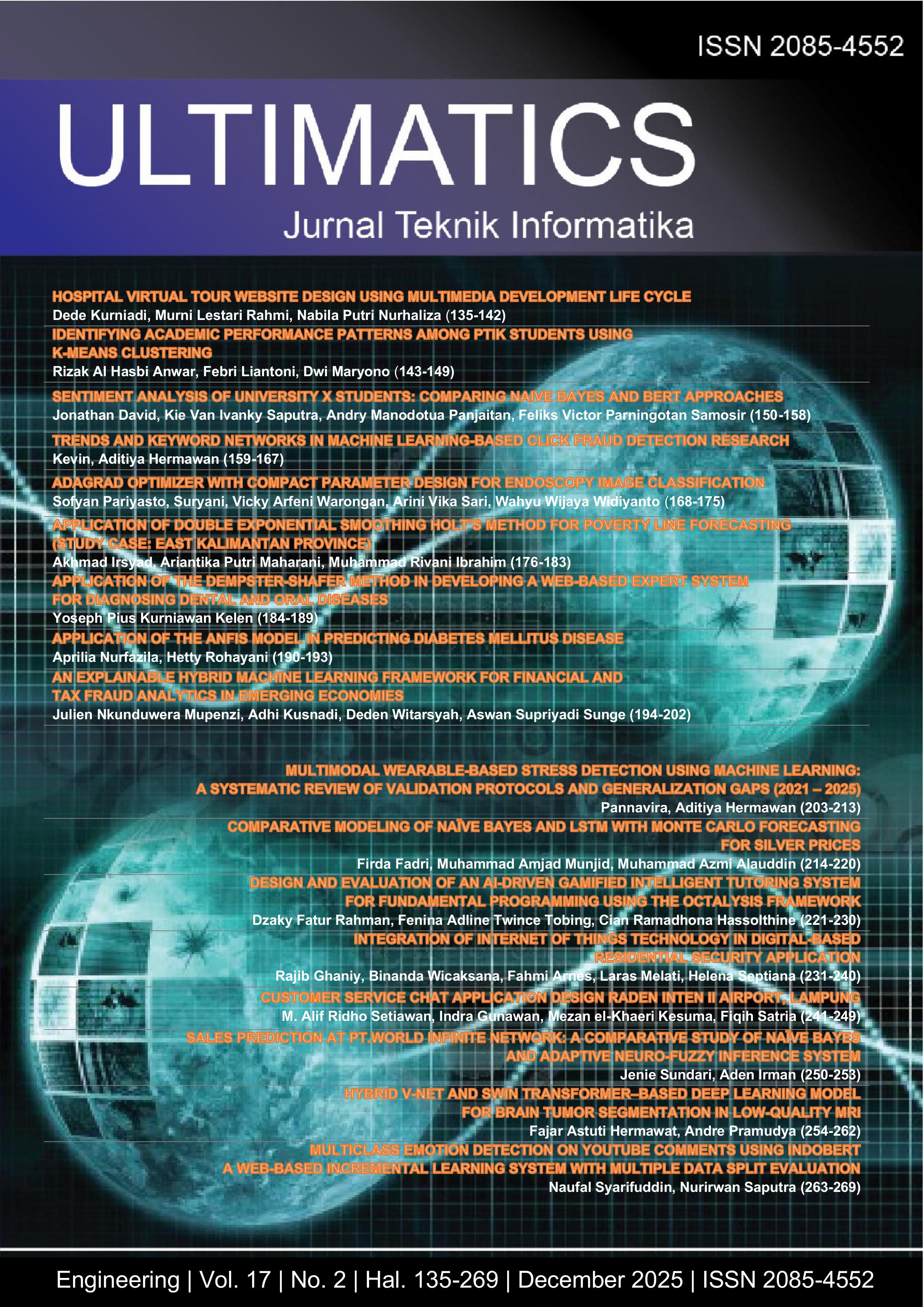
Design and Evaluation of an AI-Driven Gamified Intelligent Tutoring System for Fundamental Programming Using the Octalysis Framework
DOI:
https://doi.org/10.31937/ti.v17i2.4514Abstract
This research aims to address the challenges of student motivation and engagement in fundamental programming education by implementing the Octalysis Gamification Framework within an Intelligent Learning System. Traditional learning methods often fail to visualize abstract concepts or provide personalized feedback, leading to student demotivation. To overcome this, a platform named "Starcoder" was designed and built, integrating two conceptual pillars: the eight core drives of the Octalysis Framework and an AI-supported Intelligent Tutoring System (ITS). The system employs the Next.js framework and integrates the Gemini AI API (M.E.C.H.A.) to provide real-time, adaptive feedback and remedial learning paths. The effectiveness of the platform was evaluated using the Hedonic-Motivation System Adoption Model (HMSAM) with 54 respondents, comparing the gamified platform against traditional classroom methods. Evaluation results demonstrate that the platform significantly outperforms traditional methods, achieving an 86.44% score in Perceived Usefulness and an 85.56% score in Curiosity. Notably, Behavioral Intention to Use increased by 15.56% compared to the baseline. These findings demonstrate that the comprehensive integration of gamification frameworks with generative AI agents effectively enhances student motivation and immersion in technical education. Future work should focus on expanding the AI's capability to dynamically adjust gamification elements in real-time based on student performance.
Downloads
Additional Files
Published
How to Cite
Issue
Section
License
Copyright (c) 2026 Dzaky Fatur Rahman, Fenina Adline Twince Tobing, Cian Ramadhona Hassolthine

This work is licensed under a Creative Commons Attribution-ShareAlike 4.0 International License.
Authors retain copyright and grant the journal right of first publication with the work simultaneously licensed under a Creative Commons Attribution-ShareAlike International License (CC-BY-SA 4.0) that allows others to share the work with an acknowledgement of the work's authorship and initial publication in this journal.
Authors are able to enter into separate, additional contractual arrangements for the non-exclusive distribution of the journal's published version of the work (e.g., post it to an institutional repository or publish it in a book), with an acknowledgement of its initial publication in this journal.
Copyright without Restrictions
The journal allows the author(s) to hold the copyright without restrictions and will retain publishing rights without restrictions.
The submitted papers are assumed to contain no proprietary material unprotected by patent or patent application; responsibility for technical content and for protection of proprietary material rests solely with the author(s) and their organizations and is not the responsibility of the ULTIMATICS or its Editorial Staff. The main (first/corresponding) author is responsible for ensuring that the article has been seen and approved by all the other authors. It is the responsibility of the author to obtain all necessary copyright release permissions for the use of any copyrighted materials in the manuscript prior to the submission.