
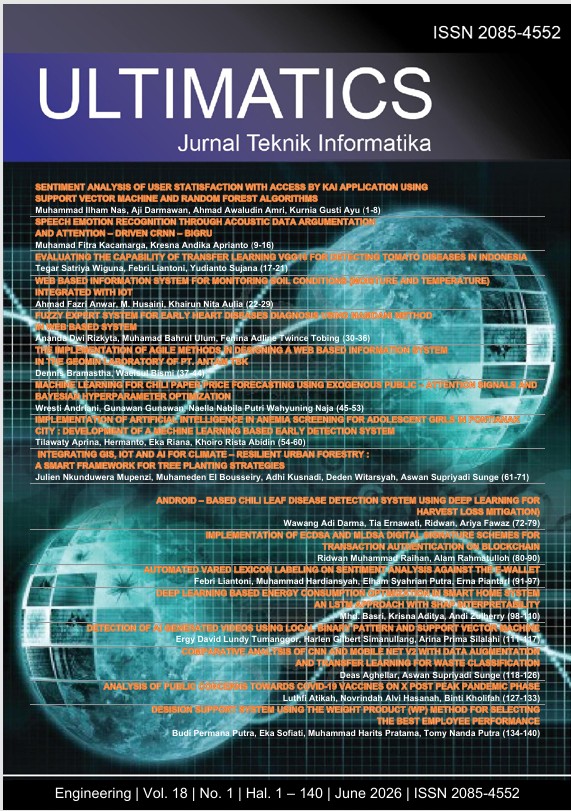
Implementation of ECDSA and MLDSA Digital Signature Schemes for Transaction Authentication on Blockchain
DOI:
https://doi.org/10.31937/ti.v18i1.4516Abstract
Blockchain technology serves as a core foundation for decentralized systems that demand high levels of security, transparency, and data integrity. However, the advancement of quantum computing introduces substantial risks to classical cryptographic algorithms such as the Elliptic Curve Digital Signature Algorithm (ECDSA), which is vulnerable to attacks targeting the discrete logarithm problem. This study proposes a hybrid digital signature scheme that integrates ECDSA with the Module Lattice-based Digital Signature Algorithm (MLDSA) to strengthen blockchain transaction authentication against both classical and quantum threats. Experimental results shown that the hybrid scheme achieves efficient performance, with an average verification time of 0.647 ms and a signing time of 0.806 ms. Although the resulting signature size reaches 6761 bytes due to the concatenation of two signatures, the hybrid approach successfully provides dual-layered cryptographic protection capable of maintaining transaction authenticity and integrity in a post-quantum environment. These findings highlight the feasibility of adopting hybrid digital signatures in blockchain systems. Future work may focus on optimizing signature size through compression techniques to improve scalability and reduce payload overhead.
Downloads
Additional Files
Published
How to Cite
Issue
Section
License
Copyright (c) 2026 Ridwan Muhammad Raihan, Alam Rahmatulloh

This work is licensed under a Creative Commons Attribution-ShareAlike 4.0 International License.
Authors retain copyright and grant the journal right of first publication with the work simultaneously licensed under a Creative Commons Attribution-ShareAlike International License (CC-BY-SA 4.0) that allows others to share the work with an acknowledgement of the work's authorship and initial publication in this journal.
Authors are able to enter into separate, additional contractual arrangements for the non-exclusive distribution of the journal's published version of the work (e.g., post it to an institutional repository or publish it in a book), with an acknowledgement of its initial publication in this journal.
Copyright without Restrictions
The journal allows the author(s) to hold the copyright without restrictions and will retain publishing rights without restrictions.
The submitted papers are assumed to contain no proprietary material unprotected by patent or patent application; responsibility for technical content and for protection of proprietary material rests solely with the author(s) and their organizations and is not the responsibility of the ULTIMATICS or its Editorial Staff. The main (first/corresponding) author is responsible for ensuring that the article has been seen and approved by all the other authors. It is the responsibility of the author to obtain all necessary copyright release permissions for the use of any copyrighted materials in the manuscript prior to the submission.