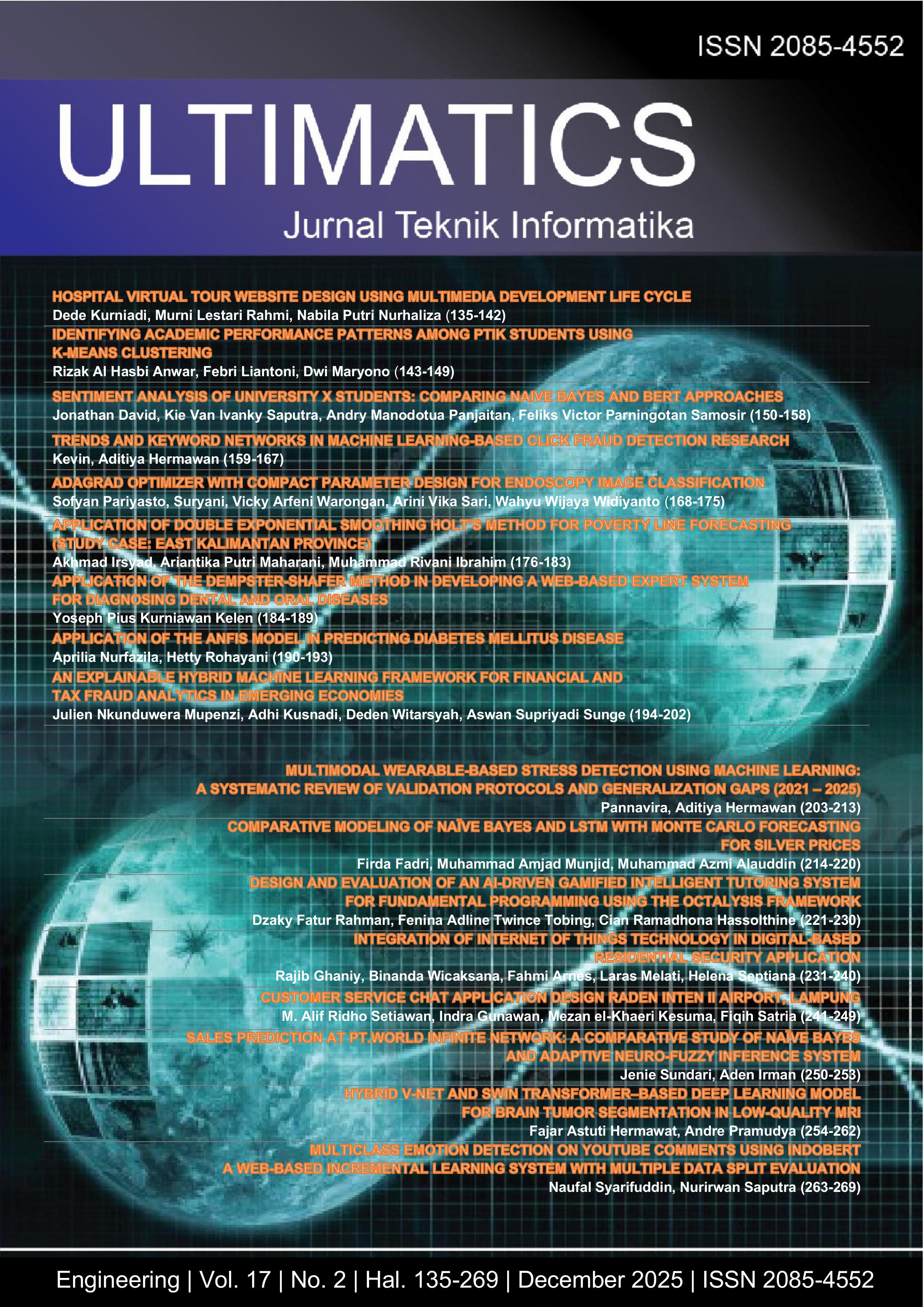
Multiclass Emotion Detection on YouTube Comments Using IndoBERT
A Web-Based Incremental Learning System with Multiple Data Split Evaluation
DOI:
https://doi.org/10.31937/ti.v17i2.4558Abstract
YouTube comments contain rich emotional expressions, but their large volume makes manual analysis inefficient. This study proposes a multiclass emotion classification approach for Indonesian YouTube comments using the IndoBERT model integrated with a database-driven incremental learning system.
Comment data were collected through the YouTube Data API and labeled into six emotion categories: anger, sadness, happiness, fear, surprise, and neutral. Text preprocessing included lowercasing, text cleaning, and normalization of informal Indonesian words. The model was fine-tuned using three training–testing split scenarios (60:40, 70:30, and 80:20).
The results show that the 80:20 split achieved the highest accuracy of 68%, influenced by an imbalanced class distribution with underrepresented minority classes. In addition, the system supports continuous data storage and incremental retraining, allowing the model to learn from new data without retraining from scratch. This adaptive mechanism makes the proposed system suitable for long-term emotion analysis on YouTube comments.
Downloads
Additional Files
Published
How to Cite
Issue
Section
License
Copyright (c) 2026 Naufal, Nurirwan Saputra

This work is licensed under a Creative Commons Attribution-ShareAlike 4.0 International License.
Authors retain copyright and grant the journal right of first publication with the work simultaneously licensed under a Creative Commons Attribution-ShareAlike International License (CC-BY-SA 4.0) that allows others to share the work with an acknowledgement of the work's authorship and initial publication in this journal.
Authors are able to enter into separate, additional contractual arrangements for the non-exclusive distribution of the journal's published version of the work (e.g., post it to an institutional repository or publish it in a book), with an acknowledgement of its initial publication in this journal.
Copyright without Restrictions
The journal allows the author(s) to hold the copyright without restrictions and will retain publishing rights without restrictions.
The submitted papers are assumed to contain no proprietary material unprotected by patent or patent application; responsibility for technical content and for protection of proprietary material rests solely with the author(s) and their organizations and is not the responsibility of the ULTIMATICS or its Editorial Staff. The main (first/corresponding) author is responsible for ensuring that the article has been seen and approved by all the other authors. It is the responsibility of the author to obtain all necessary copyright release permissions for the use of any copyrighted materials in the manuscript prior to the submission.